Clinic

Painting entitled "Clinic" by Martina Gangle Curl


This painting is one of the many treasures uncovered in the Gold Room.  Painted by the Oregon artist Martina Gangle Curl, it depicts a man using a stethoscope to listen to the heartbeat of a small child, while his headlight shines on red-haired woman with her hand on her chest.  A reluctant figure stands in the dark background, hand held up to its distressed face. 

Curl (1906-1994) was a prominent Oregon painter, printmaker and social activist.  She attend the Museum Art School in Portland and worked with the WPA Federal Art Project and federally funded Oregon Art Project on public art at Timberline Lodge, Rose City Park Elementary School and Pendleton High School.  A one time member of (more…)

Tagged with:
 

Postcard Views from the Past

These vintage postcards of the Oregon State Insane asylum are part of a collection put together by OSH Director of Quality Improvement Ted Ficken.   Postcards of important government buildings, like the Oregon State Hospital, were used for all sorts of communication purposes.  Two of the postcards in the collection have messages written on them.   While the messages aren’t directly related to OSH, they are interesting slices of history…

(more…)

OMC Laundry Cart

OMC Laundry Cart

This wooden laundry cart was found in 35c.  Does anyone know what “OMC” stands for?  Or remember seeing this cart in use?


Bits and Pieces

Miscellaneous parts found during inventory. Item in lower right corner was later found to be a piece broken off of a set of cast iron scales.

These miscellaneous parts were found during the inventory process.  While they may look like junk (and many of them may turn out to be just that), the innocuous looking metal piece T2009.002.053 proved to be much more.  About three weeks after it was found, it was identified as a missing piece from a set of Henry Troemner scales. 

Henry Troemner started manufacturing commercial scales in 1838 in Philadelphia and received a contract to make scales for the US Mint.  Sometime after 1856, they started making pharmaceutical scales.  The company is still in business today. 

Not every item inventoried is historic or will become part of the museum, but every item found is numbered and kept until it can be identified.   

Henry Troemner Scales (T2009.002.108) reunited with its missing piece (T2009.002.053)


MHP Mystery

Mysterious tag found on several objects in the collection.

Several items inventoried have tags on them, like those in the picture above,  that read “MHP Collection.”  Does anyone know anything about these tags or what “MHP” stands for? 

Three items have been found so far with this tag on them.  These include: 

 
  • Krasno-Ivy Flicker Photometer made by the Clinical Instruments Co.
  • Electro-Shock Therapy Apparatus
  • GE Cardioscribe
  • Framed photograph of unidentified building (see image below)


Photo of the Eastern Oregon State Hospital (T2009.002.197). This framed photo also bears the mysterious MHP tag.


Cork Sizer

[youtube=http://www.youtube.com/watch?v=pRuiLQTE1iU]

This Cork Sizer was made by the Enterprise Manufacturing Company of Philadelphia, PA.  An impression on the object lists the patent date of the piece as August 7, 1867, although the US Patent database lists no patents being issued on that date.

Corked bottles line the shelves of the Infirmary at the Oregon State Hospital in Salem. Oregon State Archives, Oregon State Hospital, OSH0015

“Cork sizers were integral to an apothecary’s work in that most of the liquid prescriptions and medications that they made and filled would have been sealed into glass jars using a cork,” explains Callie Stapp, Associate Curator of the Stabler-Leadbeater Apothecary Museum in Alexandria Virginia.  “Corks came in a number of different sizes based on the size of the neck of the bottle that they would have been used in. A cork would have been soaked in water for a few minutes and then put into the sizer to reduce it to the necessary size and placed in its bottle to dry and expand, thus making a tight, waterproof seal.”

The orange flag on this piece marks it as Oregon State Historic Property, identified and inventoried by the Oregon Heritage Commission and State Parks and Recreation Department.

1000 Items Inventoried!

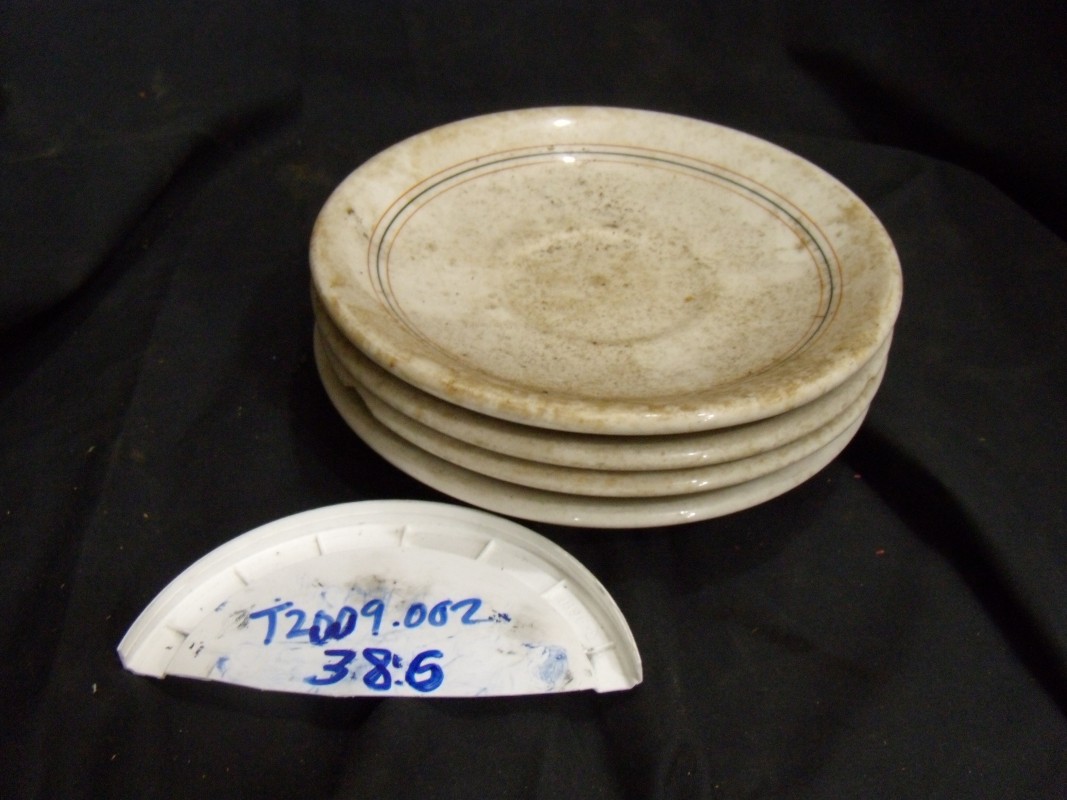
T2009.002.096

As part of the preparations for a new museum at the Oregon State Hospital Campus in Salem, an inventory of historic property has been underway since August.  Last week the number of total artifacts documented reached over one thousand, a mere fraction of the total number of objects in storage at the Salem Campus.

In the inventory process, each item is given a unique number and tagged.  The number is then entered into a database with information about the item including its name, composition, class of artifact, location, manufacturer, owner, age and medium.

Artifacts are classified into six broad categories based on their use at the hospital: Buildings and Furnishings (furniture, light fixtures, silver service); Tools and Equipment for Administration (typewriters, feather duster, copy press); Tools and Equipment for Science and Technology (Medical equipment, regulative and safety equipment); Tools and Equipment for Materials (sewing machines, woodworking tools); Recreational Equipment (piano, pool table), and Communication (archival documents, records, photographs, memorabilia). 

Storage area for many of the items inventoried


Tagged with:
 

Thera Cycle

Theracycle

Two of these machines have been found.  They are primarily stationary bikes, but the pedals drive a belt that appears to run a scroll or jig saw mounted on a platform where the handle bars would traditionally be.  The brand or model name “Thera Cycle” is cast into the “U-shaped” bracket support that extends out to the front of the machine, opposite the seat.  The machines are both painted red and black, have wooden adjustable seats and are missing the saw blades. 

Here are the questions we are hoping someone out there might be able to help us answer:

  • How was this machine used in the hospital?
  • When was it used?
  • Where was it used?
  • Is it a commerically mass-produced product or a custom design?
Detail view of saw mechanism.  Both machines are missing their saw blades.

Detail view of saw mechanism. Both machines are missing their saw blades.

Tagged with: